

Marine Electrical Systems
YACHT TECHNICAL SERVICE
MARINE ELECTRICAL SYSTEMS
Electronic navigation aids, Interior lighting, Solar panel sales and installation, Battery sales and installation, Complete electrical system wiring and localized repairs, Battery charger (shore power charger) and inverter supply and installation
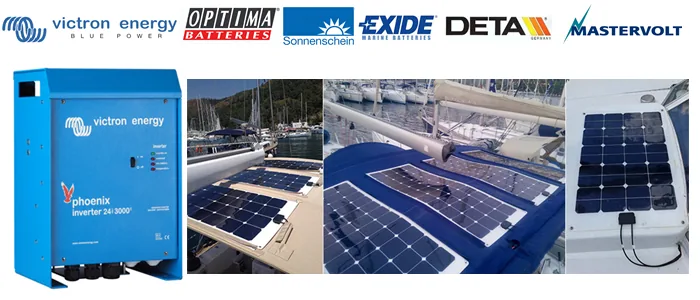
Marine electrical systems underpin safety, comfort and navigation electronics. Weak connections, undersized cable, ageing battery banks or poorly matched chargers lead first to faults and then to fire risk. At Sound Yachts in Yalıkavak Marina we treat AC/DC distribution, chargers, inverters, lighting and nav power as one system.
Work typically follows: review of existing diagrams and panels; voltage and drop checks; battery health and connection resistance; separate review of critical loads (autopilot, radar, refrigeration, lighting); then repair, reinforcement or rewiring. When adding kit—lithium conversion, a larger inverter, solar—capacity and protection (fuses, bus bars, bonding) are recalculated together.
Act when breakers trip repeatedly, lights dim under load, chargers run hot, salt corrosion appears, electronics reset without cause, or shore-power RCD trips. Pre-season panel cleaning and torque checks prevent many failures. Jeanneau, Contest, Saxdor and Bali layouts differ; authorised-service experience reduces wrong cable sizes and protection mistakes.
Being inside the marina speeds shore-power testing and parts access. Jobs fit planned maintenance windows; urgent faults are prioritised. Quality means correct cross-section, clear labelling, safe fusing and documented changes. The aim is a coherent, serviceable electrical architecture—not only one working device.
Upgrades discuss energy demand, time at anchor and generator/solar balance. Quotes list assumptions and work packages clearly. You can start with fault finding only, or move stepwise into panel renewal and energy management. Sharing symptoms via contact or quote forms speeds the survey.
Battery technology choices—gel, AGM or lithium—differ in charge profiles, ventilation needs and protection electronics. Lithium conversions require BMS, charger compatibility and a clear disconnect strategy; swapping cells alone is not enough. If solar and shore charging coexist, priority and regulation must be explicit or the systems fight each other and life shortens.
For fire safety we review cable penetrations, terminal protection and fuse placement. Correct separation between engine spaces and living areas reduces smoke/heat risk. Navigation power can suffer from noise and ground loops; when adding radar or autopilot, supply quality is tested separately.
Planning electrical work with mechanical or HVAC projects avoids opening panels and cable runs repeatedly. Sound Yachts aims to keep your energy architecture serviceable for today’s use and sensible future additions. Share symptoms and an equipment list to build a fast survey plan.
Documentation matters for later service: panel labels, an updated single-line diagram and fuse ratings are recorded so future work is not blind. Even a modest tidy-up can improve electrical safety in a measurable way.
Shore-power inlets are checked for polarity, bonding and RCD protection. Wrong connections risk equipment and deck safety, so inlet-side tests accompany new inverters or chargers.
For a survey, material selection or written quotation, reach us via Contact or Request a quote. You can also find our Yalıkavak Marina base on Google Maps.